
CONTINUOUS SAPONIFICATION PLANT FOR SEMI BOILED SOAP
Continuous saponification for semi-boiled soap provides an efficient industrial process for producing solid soap continuously from vegetable oils and animal fats. The process retains the glycerin in the soap and uses controlled saponification and vacuum drying to obtain a consistent soap base for further processing.
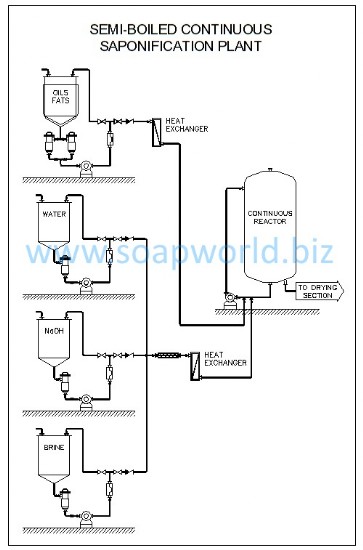
Continuous Saponification Plant for Semi-Boiled Soap
A Continuous Saponification Plant for Semi-Boiled Soap is an industrial system designed for the continuous production of semi-boiled soap from vegetable oils, animal fats and other fatty raw materials. The plant is similar to a continuous saponification system used for full-boiled soap, but it does not include a soap washing section, because the glycerin produced during saponification remains in the finished soap. This type of continuous soap saponification plant is suitable for medium and large production capacities. At the end of the reaction, the soap is transferred directly to a soap vacuum dryer, where excess water is removed.
Saponification Process
The raw materials are pumped through filters and introduced continuously into the Continuous Saponification Reactor by dedicated dosing groups. Each dosing group consists of a pump, flow meter and related control valves, allowing the different raw materials to be accurately controlled. The process feeds the reactor with:
- oil;
- caustic soda solution;
- water;
- brine.
Before entering the reactor, the raw materials pass through heat exchangers, which increase their temperature to the required operating conditions. The Saponification Reactor operates under pressure at approximately 130–140°C. The reactor does not have mechanical agitation. Instead, a recycle pump continuously circulates the soap through the reactor. This high-rate recirculation mixes the incoming raw materials with the soap already present in the reactor, creating the conditions required to complete the continuous saponification reaction. The relatively low viscosity of the soap is therefore an important characteristic of this process, allowing the recycle pump to move the soap effectively through the reactor.
Semi-Boiled Soap
At the outlet of the Continuous Saponification Reactor, the resulting semi-boiled soap is sent directly to the following processing section. Unlike full-boiled soap production, there is no washing stage to remove glycerin. The glycerin generated by the saponification reaction therefore remains incorporated in the semi-boiled soap. Because the soap contains excess water, it is subsequently transferred to a vacuum soap dryer, where the water is removed before the soap proceeds to the next stages of production. The combination of continuous dosing, heat exchange, reactor recirculation and vacuum drying provides a continuous process for producing semi-boiled soap on a medium or large industrial scale.
Knowledge Content – Browse by Topic
01. WHAT IS SOAP
02. RAW MATERIALS USED IN SOAP MANUFACTURING
07. SOAP DRYING AND COOLING
08. SOAP FINISHING LINE
09. SOAP PACKAGING