
OTHER RAW MATERIALS USED IN SOAP MANUFACTURING
Alternative fatty raw materials from refining and oleochemical processes that enrich soap formulations with quality and value.
In addition to vegetable oils and animal fats, soap manufacturers can use a range of other fatty raw materials obtained from oil refining and oleochemical production. Among the most important are soapstock, soapstock acid oil, Palm Fatty Acid Distillate (PFAD), and industrial fatty acids. These materials can provide valuable sources of fatty matter for soap production and are particularly relevant in large-scale manufacturing. Their composition and properties depend on their origin, the original oil or fat and the treatments they have undergone. Understanding these raw materials is therefore important when selecting ingredients for a consistent and economical soap formulation.
Fatty Acids
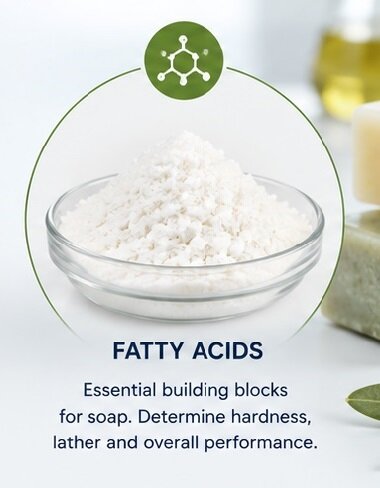
Fatty acids are another important category of raw materials used in soap manufacturing. They are organic compounds consisting of a hydrocarbon chain and a carboxylic acid group. Their chain length and degree of saturation have a significant influence on the properties of the soap produced from them. Industrial fatty acids can be obtained from vegetable oils and animal fats and are available in different grades and compositions. Common fatty acids relevant to soap manufacturing include:
- Lauric acid (C12:0)
- Myristic acid (C14:0)
- Palmitic acid (C16:0)
- Stearic acid (C18:0)
- Oleic acid (C18:1)
- Linoleic acid (C18:2)
Each fatty acid contributes differently to the characteristics of the finished soap. Lauric and myristic acids are generally associated with good cleansing and lathering properties, while palmitic and stearic acids contribute to hardness and durability. Oleic acid is commonly associated with milder and more conditioning soap.
Fatty Acids as Soapmaking Raw Materials
Using fatty acids directly gives the soap manufacturer a different starting point compared with using neutral oils and fats. Neutral oils and fats contain triglycerides, which react with an alkali during saponification to form soap and glycerol. Free fatty acids, on the other hand, can react directly with an alkali to form the corresponding fatty-acid salts. For example:
Fatty Acids + Sodium Hydroxide → Soap + Water
The resulting sodium salts of fatty acids are the principal components of many hard soaps. This type of reaction is known as neutralization and can be particularly useful when the formulation is based on fatty-acid-rich raw materials.
PFAD – Palm Fatty Acid Distillate
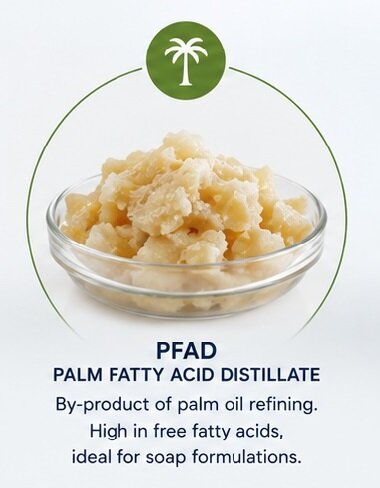
PFAD (Palm Fatty Acid Distillate) is an important fatty raw material obtained during the physical refining of crude palm oil. It consists predominantly of free fatty acids together with smaller amounts of glycerides, unsaponifiable matter and other minor components. PFAD is widely traded as an industrial fatty material and has traditionally been used in several applications, including soap manufacturing. At room temperature, PFAD is generally a semi-solid or solid material, while heating makes it easier to handle and process. Its color and composition can vary depending on the quality of the crude palm oil and the refining conditions.
PFAD in Soap Manufacturing
The relatively high free-fatty-acid content of PFAD makes it suitable for certain industrial soap formulations. Unlike neutral palm oil, which consists mainly of triglycerides, PFAD already contains a large proportion of free fatty acids. This makes it particularly useful in formulations where fatty-acid-rich raw materials are required. PFAD can contribute to the fatty-acid balance of a soap formulation and can be combined with other oils, fats or fatty materials to obtain the desired characteristics. Its suitability depends on factors such as:
- free fatty acid content;
- moisture;
- impurities;
- color;
- melting characteristics;
- oxidation stability;
- consistency of supply and specification.
For applications requiring very light-colored or highly refined soap, the quality of the PFAD becomes especially important.
From Raw Materials to Soap
Modern soap manufacturing can therefore draw on a broad range of fatty raw materials. The choice may include traditional vegetable oils and animal fats, as well as soapstock acid oil, PFAD and industrial fatty acids. Understanding the origin, composition and characteristics of these materials allows soap manufacturers to select appropriate combinations and achieve the required balance of hardness, lather, cleansing performance, color, stability and processing behavior. The right raw material selection is therefore an essential part of developing a consistent, efficient and high-quality soap formulation.
Soapstock
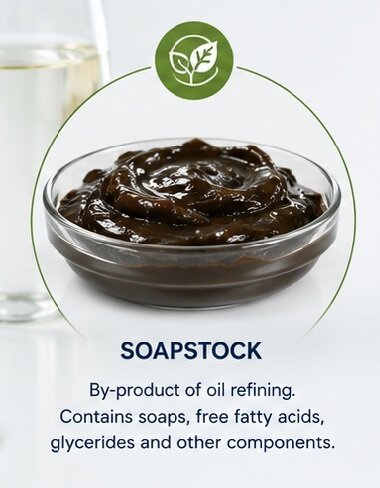
Soapstock is a by-product generated during the chemical refining of vegetable oils. During alkali refining, free fatty acids naturally present in crude vegetable oils react with an alkali, forming soaps. These soaps, together with water, phospholipids, pigments and other impurities removed during refining, are separated from the neutral oil as a material known as soapstock. Raw soapstock can contain:
- fatty acid soaps;
- free fatty acids;
- water;
- glycerides;
- phospholipids and other impurities;
- pigments;
- residual alkali.
Its composition varies according to the original vegetable oil and the refining conditions. Because raw soapstock contains a significant amount of non-fatty material, it is generally not used directly as a conventional soapmaking oil. Instead, it can be further treated to recover its valuable fatty components.
Soapstock Acid Oil
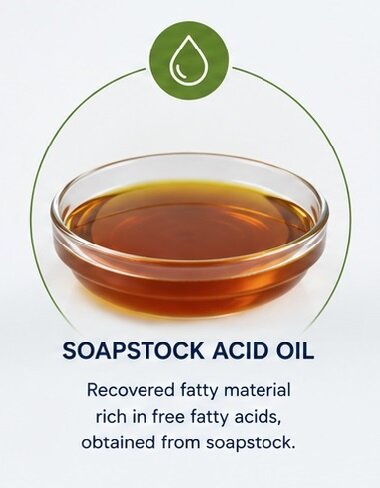
Soapstock acid oil is a dark, concentrated liquid byproduct created by treating vegetable oil refining waste with a strong acid to extract free fatty acids. It is also known as acidulated soapstock or acid oil. It is a fatty material containing a high proportion of free fatty acids. Its composition depends largely on the vegetable oil from which the original soapstock was produced. It can also contain residual glycerides, moisture and other minor components. For soap manufacturers, acid oil can represent an economical source of fatty matter, particularly for formulations where high quality or a very light-colored final soap is not required. The properties of acid oil should always be evaluated according to its actual specification rather than assumed from its name or origin. Important parameters can include:
- free fatty acid content;
- moisture;
- impurities;
- color;
- odor;
- oxidation level;
- melting characteristics.
Selecting Fatty Raw Materials for Soap Formulation
The choice between vegetable oils, animal fats, soapstock acid oil, PFAD and industrial fatty acids depends on the characteristics required for the finished soap. Manufacturers may consider:
- fatty-acid composition;
- hardness;
- lather;
- cleansing performance;
- solubility;
- color;
- odor;
- oxidation stability;
- processing characteristics;
- availability;
- cost.
The raw material does not need to provide every desired property by itself. Different fatty materials can be combined to create a balanced formulation. For industrial soap production, consistency between batches is particularly important. Raw materials should therefore be purchased and controlled according to clearly defined specifications.
Oils, Fats and Recovered Fatty Materials
The soap industry can therefore use several different sources of fatty matter. Vegetable oils and animal fats are traditional triglyceride-based raw materials used for saponification. Soapstock acid oil and PFAD provide fatty-acid-rich materials originating from vegetable oil refining. Industrial fatty acids provide more directly defined fatty-acid components that can be used in formulations requiring specific properties. These materials can be used individually or combined, depending on the formulation and the manufacturing technology.
Why These Raw Materials Are Important
The availability of secondary fatty materials gives soap manufacturers additional flexibility when designing economical and technically consistent formulations. Soapstock acid oil and PFAD can provide useful fatty matter derived from the processing of vegetable oils, while industrial fatty acids allow manufacturers to work with more specifically defined fatty-acid compositions. Their use can therefore contribute not only to raw material cost optimization, but also to the efficient utilization of materials generated by the vegetable oil and oleochemical industries. However, lower cost does not necessarily mean lower quality requirements. Each material must be evaluated according to its chemical and physical specifications and its suitability for the intended soap.
Knowledge Content – Browse by Topic
01. WHAT IS SOAP
02. RAW MATERIALS USED IN SOAP MANUFACTURING
07. SOAP DRYING AND COOLING
08. SOAP FINISHING LINE
09. SOAP PACKAGING