
SOAP VACUUM DRYER
A Soap Vacuum Dryer is an essential part of industrial soap manufacturing, used to remove excess moisture from soap after the saponification process. Vacuum drying controls the final moisture content and TFM of the soap, producing a concentrated soap base ready for further finishing and extrusion.
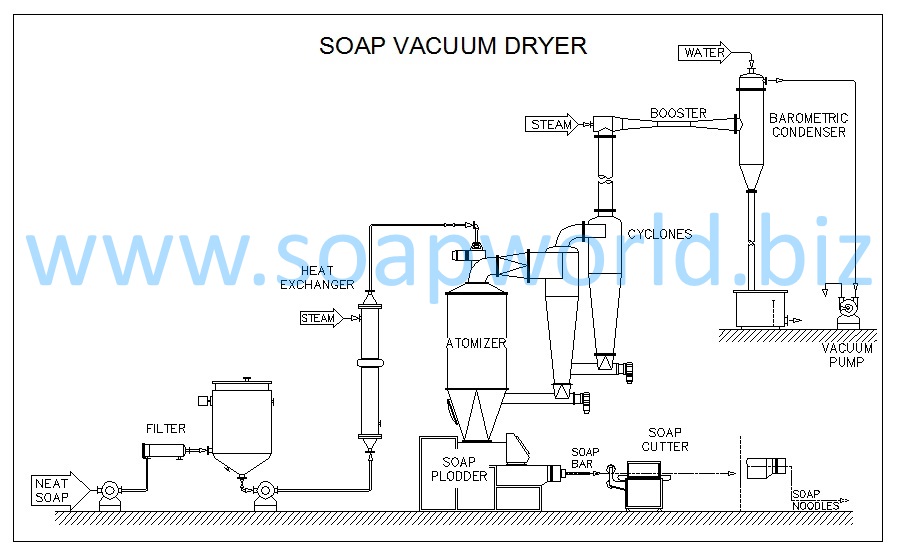
Soap Vacuum Dryer
The Soap Vacuum Dryer, also known as a Vacuum Drying Plant or Soap Dryer, is used to reduce the moisture content of soap after the saponification process. By adjusting the moisture level, the plant allows manufacturers to obtain soap with the required TFM (Total Fatty Matter). The vacuum drying system was invented in Italy in the middle of the last century and represented an important development in the industrial soap manufacturing process, making it possible to achieve large production capacities with relatively low manpower requirements.
Soap Vacuum Drying Process
The soap leaving the saponification plant is first filtered and then pumped to the Vacuum Drying Plant by a soap feed pump. Before entering the drying system, the soap can pass through a heat exchanger. The production rate of the plant is determined by the speed of the soap feed pump. The soap is then sprayed onto the wall of an Atomizer (Vacuum Chamber). The operating conditions inside the Atomizer allow the sprayed soap to dry and cool rapidly. The dried and cooled soap is immediately scraped from the wall. The moisture evaporated during this process is conveyed through vapor ducts and cyclones to a barometric condenser. A vacuum pump moves the vapors toward the condenser, where they are condensed through direct contact with cooling-tower water. The resulting water flows through the barometric leg into the Hot Well. Any non-condensable gases, such as air, are removed by a liquid-ring vacuum pump group. During their passage through the cyclones, the vapors are separated from the soap dust carried with them. The recovered soap fines collect at the bottom of the cyclones. A fines screw conveyor transfers the material from the second cyclone to the first cyclone, where another screw conveyor returns it to the Atomizer. Some Vacuum Drying Plants are designed with only one cyclone. The dried and cooled soap scraped from the Atomizer falls onto the worms of a soap plodder. The plodder can be either Simplex or Duplex and extrudes the soap in the form of continuous soap noodles. This provides the soap mass in a suitable form for the subsequent stages of the soap manufacturing process.
Vacuum Drying for Laundry Soap
In the production of pure or filled laundry soap, the heat exchanger can be bypassed because pre-evaporation of moisture is not necessary. For this type of soap, the vacuum level obtainable with the standard vacuum group is not sufficient. A Booster is therefore required to provide an additional pressure drop. A Booster is also necessary when the available cooling water temperature exceeds 26°C. For laundry soap manufacturing, the Atomizer is assembled directly on a Duplex Vacuum Plodder. The first stage of the Duplex Plodder refines the soap, while the second stage extrudes it into a soap bar, which is subsequently cut and printed using a soap cutter.
Moisture and TFM Control
One of the most important functions of the Soap Vacuum Dryer is the control of the final moisture content. The moisture percentage can be adjusted by controlling the temperature of the heat exchanger and the vacuum level. A neat soap produced by the saponification plant, with a TFM of approximately 58–60%, can be concentrated to approximately 78–80% TFM by removing a significant amount of the moisture contained in the neat soap. The Vacuum Drying Plant therefore plays an important role in determining the final concentration of the soap before it proceeds to the subsequent soap finishing and extrusion stages.
Knowledge Content – Browse by Topic
01. WHAT IS SOAP
02. RAW MATERIALS USED IN SOAP MANUFACTURING
07. SOAP DRYING AND COOLING
08. SOAP FINISHING LINE
09. SOAP PACKAGING