
KETTLES SAPONIFICATION PLANT FOR FULL BOILED SOAP
Kettle saponification is a traditional batch process used to produce full-boiled soap from vegetable oils and animal fats. The process combines saponification, graining, washing and fitting to obtain a soap base suitable for further industrial processing.
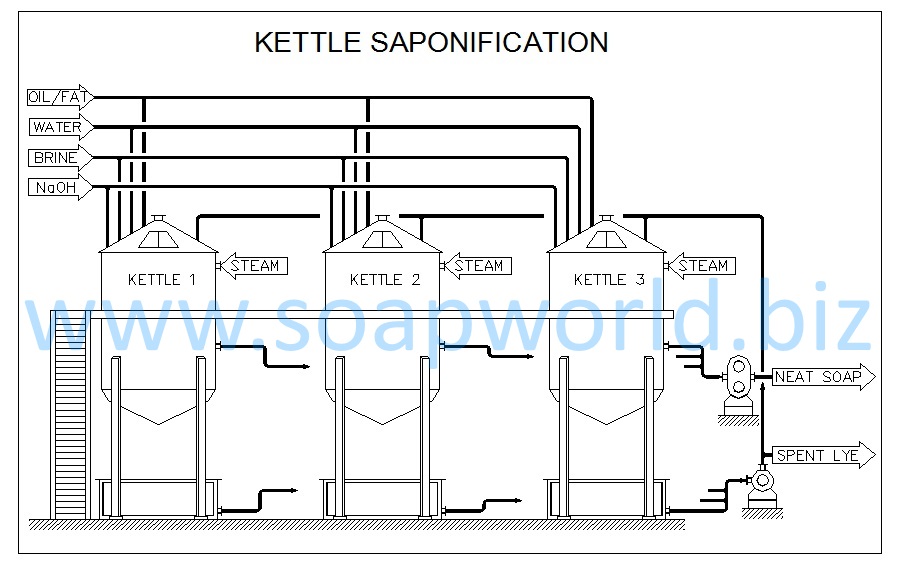
Kettle Saponification Plant for Full-Boiled Soap
The kettle saponification plant is one of the oldest systems used for producing soap and glycerin from vegetable oils and animal fats. Although modern continuous saponification technologies have replaced traditional kettle systems in few industrial soap factories, kettle saponification remains an important technology from a historical and technical perspective. Over the years, the traditional process has also been improved through technologies such as JET saponification systems.
The main limitations of traditional kettle saponification are its high steam consumption, long processing time, limited flexibility when formulations need to be changed, large installation area and the need for experienced soap makers.
In a traditional kettle saponification plant, three or more kettles are normally installed. Depending on the plant design, individual kettles can have capacities ranging from approximately 10 to 100 cubic meters.
A spiral steam coil is installed in the lower part of each kettle. Steam provides the heat required for the process and also contributes to the mixing of the raw materials. The direction and distribution of the steam flow are important because they must create an effective circulation pattern inside the kettle. Proper circulation helps maintain a homogeneous mixture and ensures that the oils, fats and caustic soda are effectively brought into contact during the saponification reaction.
An additional kettle is normally provided as a reserve or correction kettle. It can be used when a process problem occurs and the mixture requires correction. For example, if an incorrect quantity of oil or caustic soda has been introduced into a saponification kettle, the mixture can be transferred to the additional kettle so that the formulation can be adjusted.
The raw materials are introduced into a kettle that already contains a quantity of lye, helping to initiate the saponification reaction.
Once saponification is completed, the process moves to the soap graining stage. A brine solution consisting of sodium chloride (NaCl) and water is added to the kettle and mixed with the soap.
The addition of brine promotes separation of the mixture into two layers. The soap rises toward the upper part of the kettle, while the lower layer contains glycerin, water and excess sodium hydroxide.
After separation, the mixture is allowed to settle and the lower spent lye is removed from the kettle. The lye can then be transferred to another kettle as part of a counter-current washing process. This arrangement allows the same lye to be used progressively to wash the soap and recover a greater quantity of glycerin during the successive washing stages.
The washing process is repeated until the soap reaches the required condition. The spent lye, which becomes increasingly rich in glycerin, can subsequently be sent to a glycerin recovery plant. The final stage is known as fitting. This operation is used to remove excess lye and adjust the free alkalinity and sodium chloride content of the soap.
The resulting product is known as Full-Boiled Soap and typically has a TFM (Total Fatty Matter) of around 60%.
Once the saponification and washing process has been completed, the soap is pumped to the vacuum drying plant, where excess water is removed before the soap proceeds to the subsequent finishing stages.
Knowledge Content – Browse by Topic
01. WHAT IS SOAP
02. RAW MATERIALS USED IN SOAP MANUFACTURING
07. SOAP DRYING AND COOLING
08. SOAP FINISHING LINE
09. SOAP PACKAGING