
CONTINUOUS SAPONIFICATION PLANT FOR FULL BOILED SOAP
Continuous saponification is a modern industrial process for producing full-boiled soap from vegetable oils and animal fats with high production capacity and precise process control. Continuous soap plants integrate saponification, soap separation, washing and neutralization to produce a consistent soap base ready for vacuum drying and finishing.
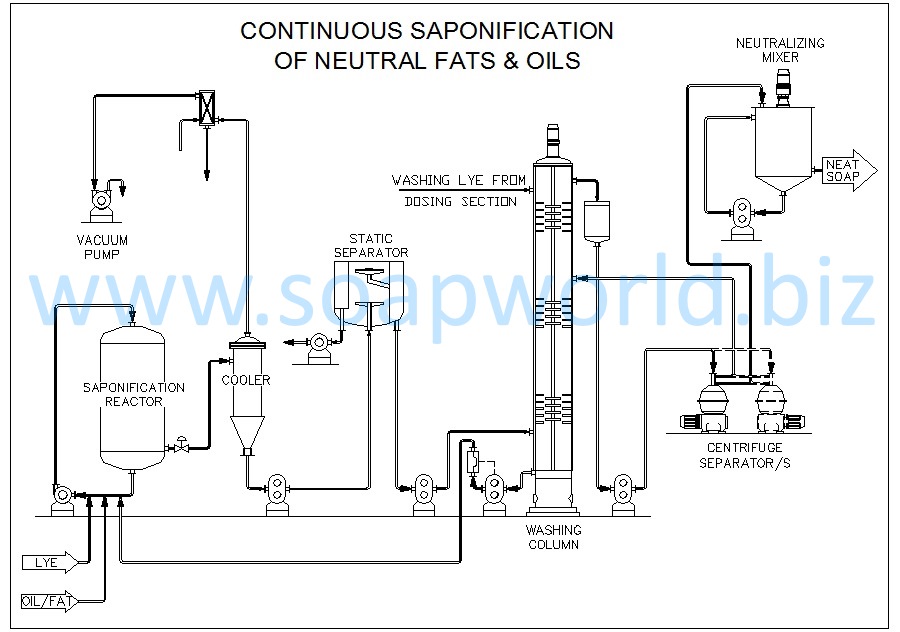
Continuous Saponification Plant for Full-Boiled Soap
A continuous saponification plant is a modern industrial system designed to produce full-boiled soap and glycerin continuously from vegetable oils and animal fats. Compared with traditional kettle saponification, continuous plants provide higher production capacity, better process control and more consistent operating conditions. They are generally used for medium- and large-scale soap manufacturing, with typical capacities ranging from approximately 3 to 15 tons of full-boiled soap per hour.
Continuous Saponification Process
The oil blend and lye solution are accurately dosed in the required proportions through a dedicated dosing system. The lye consists of caustic soda, brine and water. Volumetric pumps equipped with flow meters control the quantities of the different raw materials. Before entering the saponification reactor, the oil blend and lye are heated using heat exchangers. The heated raw materials are then introduced into the suction side of a recycle pump installed below the saponification reactor. The pump continuously circulates a large quantity of soap through the reactor. The saponification reactor is a static vessel with a specially designed internal geometry. It operates under pressure at a temperature of approximately 130–140°C. Under these conditions, the vegetable oils and animal fats react rapidly with the caustic solution. The reaction is also promoted by injecting a relatively small quantity of fresh raw materials into a continuous stream of already formed soap.
Soap Separation and Washing
After leaving the saponification reactor, the soap and lye mixture is transferred to a cooler, where it is brought down to the temperature required for graining and separation. The cooled mixture then enters a static separator. Because soap is lighter than the aqueous lye phase, it separates and floats above the lye. The lower phase, known as spent lye, contains a high concentration of glycerin and only traces of sodium hydroxide. It is normally sent to a glycerin recovery plant for further processing. The separated soap overflows into a constant-level tank and is then pumped to the washing column. The washing column uses a rotary disc contactor. A washing solution consisting of caustic soda, brine and water is heated through a heat exchanger and distributed through the soap by the rotating action of flat discs mounted on a vertical rotor shaft. As the washing solution moves downward through the column, it becomes enriched with glycerin. The resulting liquid, known as half-spent lye, is collected at the bottom of the washing column. Because this lye still contains a significant amount of sodium hydroxide, it can be pumped back to the saponification reactor, where the remaining free caustic soda can react with the incoming fatty materials.
Neutralization of Full-Boiled Soap
After washing, the soap overflows into another constant-level tank and is pumped to one or more centrifugal separators. The separated soap may still contain excess sodium hydroxide. It is therefore transferred to a neutralization section, where the free alkalinity is adjusted. The neutralization section consists of a neutralizer mixer and recycle pump that creates vigorous circulation through the neutralizing mixer. A controlled quantity of a neutralizing fatty material, such as coconut oil, palm kernel oil (PKO) or distilled fatty acids (DFA), is added through a dosing pump. After neutralization, the resulting product is full-boiled soap, typically with a TFM (Total Fatty Matter) of approximately 61%. The finished soap is then pumped to the vacuum drying plant, where excess water is removed before the soap proceeds to the subsequent finishing stages.
Knowledge Content – Browse by Topic
01. WHAT IS SOAP
02. RAW MATERIALS USED IN SOAP MANUFACTURING
07. SOAP DRYING AND COOLING
08. SOAP FINISHING LINE
09. SOAP PACKAGING